Most travellers arriving in Croatia head straight for Dubrovnik or Split. But those who make the turn toward the northern Adriatic discover something rarer – an island that has quietly been doing everything right for centuries. Krk is that island.
Connected to the Croatian mainland by a bridge since 1980, Krk is the largest island in the Adriatic by area, yet it somehow manages to feel like a secret. It is the kind of place where medieval lanes open onto harbours crowded with wooden fishing boats, where a Roman mosaic might be embedded in the floor of a café, and where the sea glows with a particular shade of blue that you will spend years trying to describe to people who weren’t there.
An Island With Layers
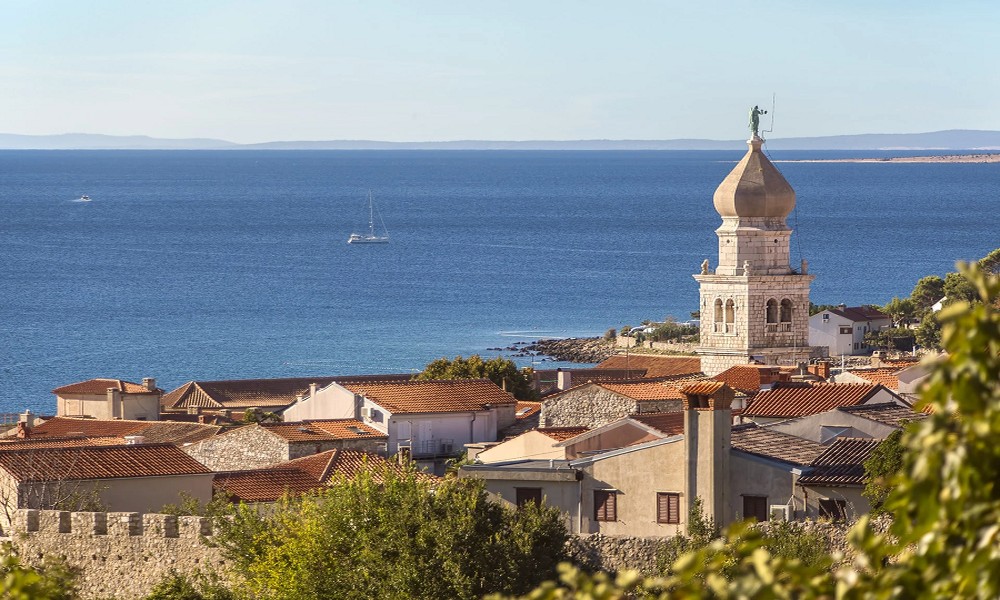
Krk has been inhabited since the Bronze Age. The Romans built baths here. A Frankopan aristocratic dynasty turned it into a cultural capital of the Adriatic for centuries. The result is an island layered with history in the most literal sense – you can stand in the old town of Krk and look at a Romanesque cathedral built atop a Roman bathhouse built atop an even earlier settlement. The stones themselves feel like a timeline.
But this history never weighs the place down. Krk wears its past lightly. The medieval walls of Krk Town enclose not a museum but a living community: women hanging laundry from windows that have been doing exactly this for five hundred years, children kicking footballs through narrow passages, bakeries opening before dawn so the smell of bread fills the streets before the tourists wake.
“Krk wears its past lightly – the medieval walls enclose not a museum but a living community.”
Beyond the Capital: An Island of Villages
The town of Krk is just the beginning. The island’s interior is a landscape of dry-stone walls, ancient olive groves, and quiet villages that see only a fraction of the coastal traffic. Vrbnik, perched on a cliff above the sea, is the home of Žlahtina – a crisp local white wine that tastes improbably good with fresh scampi from the same harbour below. The village itself is so narrow in places that two people cannot walk side by side.
Baška, at the southern tip of the island, offers a long pebble beach set against a dramatic backdrop of bare limestone mountains. It is also where, in 1851, archaeologists discovered the Baška Tablet – one of the oldest inscriptions in the Croatian language, carved into stone in the eleventh century. The original now sits in Zagreb, but a replica stands in the village church, and the sense of quiet significance it radiates is entirely real.
Punat, home to one of the Adriatic’s largest marinas, is the base for boat trips to the islet of Košljun, where a Franciscan monastery founded in the fifteenth century sits surrounded by dense forest, its interior housing an extraordinary collection of manuscripts, maps, and ethnographic objects collected by the monks over five centuries of quiet scholarship.
Essential Stops on Krk
- Krk Town– Roman walls, Frankopan castle, and the Romanesque cathedral
- Vrbnik– cliff-top village and the birthplace of Žlahtina wine
- Baška– the island’s finest beach and the Baška Tablet heritage site
- Košljun Islet– Franciscan monastery accessible by short boat from Punat
- Kornić– a quiet inland village with sweeping views and near-zero tourists
- Njivice– a sheltered harbour ideal for swimming and slow mornings
The Sea, Obviously
It would be dishonest to write about Krk without dwelling on the water. The Adriatic here is exceptionally clear – the kind of transparent that makes you want to apologise to the fish for disturbing them. The island has dozens of beaches, from the organised and accessible to the completely wild. A short walk or kayak ride from most settlements will deliver you to a cove with no name, no bar, and nothing but limestone rock and the sound of small waves.
The bura – the fierce north-easterly wind that periodically scours the Kvarner Gulf – is worth mentioning too, not as a deterrent but as a phenomenon. When the bura blows, the sea takes on a restless, pewter quality; the light changes; the whole island feels briefly electric. Locals treat it with relaxed familiarity. It is part of Krk’s character, not a flaw in it.
When to Visit
July and August bring crowds, but Krk absorbs them more gracefully than most Adriatic destinations – its size and the spread of its villages mean that genuine solitude is always available if you want it. The shoulder seasons are exceptional: May and June offer warm seas without the peak heat, and the wildflowers across the island’s interior are extraordinary in early summer. September and October bring a soft, golden quality to the light and the particular pleasure of empty beaches.
The island is accessible year-round via the bridge from the mainland or ferry connections across the Kvarner Gulf, which means it rewards return visits in different seasons without the logistical complexity of more remote Adriatic islands.
There is a certain kind of travel destination that does not announce itself. It does not trend loudly or generate a particular strain of content. It simply continues to exist, getting incrementally better at being itself, waiting for travellers who have grown tired of the obvious choices and are looking for something that will leave a mark.
Krk is that destination. The bridge makes it easy to reach, but the island rewards those who take their time. Stay longer than you planned. Walk the inland paths. Order the Žlahtina. Watch the bura come in across the water.
Ready to discover everything Krk has to offer?